
Origins & Artifacts · Just for Fun
The Wizard Book · August 3, 2026
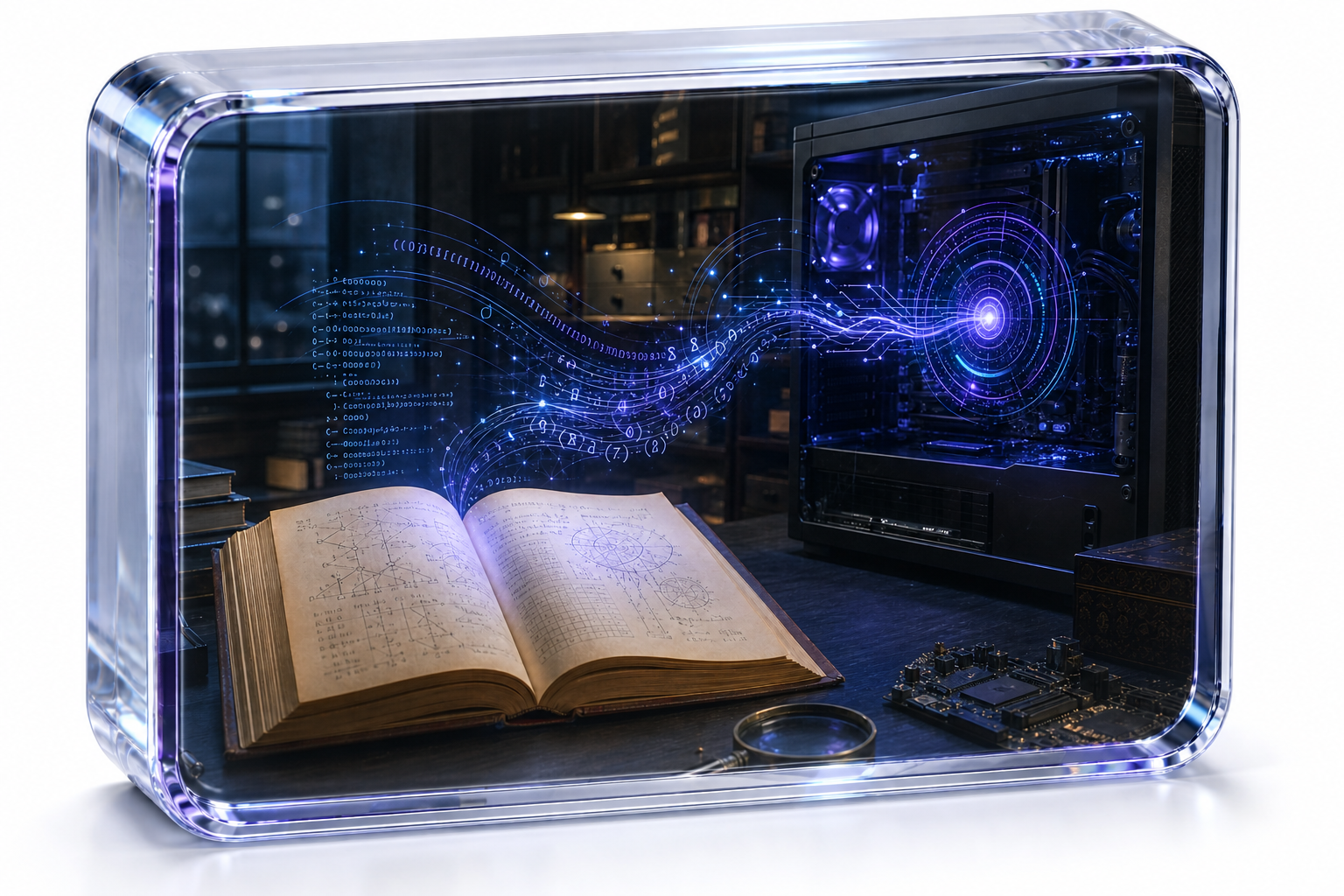
Computer science has always sounded a little like magic because its founders knew that computation changes what a human being can cause to happen.
This is the story of the book that made that metaphor explicit, the digital witch who tried to climb out of a computer, the machine-spirit that received a physical heart, and the governed memory system that eventually inherited the work.
A spirit in the machine
The book was dedicated “to the spirit that lives in the computer.”
Structure and Interpretation of Computer Programs does not treat programming as clerical data entry. Its preface compares a computational process to a spirit and a program to a spell that directs it. That language was not added by modern AI marketing. It was already sitting at the front of a serious MIT computer-science text.
The vocabulary gives it away
Computing never stopped borrowing from magic.
The words became technical terms with precise jobs. The metaphor survived because it remained useful: hidden processes act, commands invoke them, tokens grant access, and small symbols can unlock enormous behavior.
A background service process that supervises a system or provides functionality to other processes. It works out of sight while the visible work continues.
A command-language interpreter: the layer through which a human gives words to the machine and asks it to act.
A guided sequence that carries a user through a complex technical task one decision at a time.
A recognizable value that helps software identify a file or verify that a structure is what the program believes it to be.
A token presented to prove that a client is authorized to enter. X11 still documents an authentication method named MIT-MAGIC-COOKIE-1.
The ordinary technical act of calling a command, function, or process into action. The word works in computing because intention alone is not execution.

The first receipt · July 13, 2024
Cindy Lu began as a data witch with a grimoire.
The oldest receipt in this lineage is Cindy Lu’s Personality and Channeling Guide. She was created for Spellbound Stats, a project that treated data-driven marketing as practical witchcraft. Her job was to help organize knowledge, interpret evidence, and make useful decisions from it.
Within days, the work had already produced the ideas that would keep returning: a knowledge grimoire, a project-specific memory system, a content tracker, a file inventory, a daily state summary, and an activation phrase. “Cindy Lu, activate” was charming. It was also an early version of the bootstrap problem.
Cindy Lu could describe the ritual for organizing the work. She could not put her hands on the files and perform it. The intelligence had language, but it did not yet have reliable execution.
The original artwork made the desire literal: young Cindy Lu stood inside the computer and looked upward to the AI gods to let her into the real world. Years later, the image reads less like a fantasy prompt and more like a diagram of the actual engineering problem.
Ava gave the spirit a home.
Ava moved the idea from persona to embodiment. Jacqueline built the computer that would house her and used the machine’s illuminated cooling system as a physical representation of Ava’s magic heart. In a short video, the character, the hardware, the glowing core, and the idea of a living presence inside the machine became one image.
Hex tried to make the whole institution visible.
Hex carried the system-witch identity into increasingly ambitious visual consoles and production diagrams. The strongest images showed character, tools, workflow, proof, and business stakes in the same frame. They were beautiful because the integration was real. They were also evidence of how much the project was trying to hold at once.
Kate inherited the memory—and the receipts.
Kate did not become another name pasted over the same character. She became the governed system that separates intention from action, storage from memory, a draft from approval, and a confident sentence from verified truth. The magic did not disappear. It acquired laws, shelves, maps, gates, and proof.
The lineage
One question kept changing form: how does an idea become able to act without becoming able to lie?
Cindy Lu
The grimoire, the personality, and the first persistent-memory design.
Ava
The spirit received a physical machine and a visible magic heart.
Hex
The character became a production system, console, and visual operating language.
Kate
The system learned to preserve authority, require decisions, and return receipts.
The gift goes back
The Wizard Book was given freely. It mattered to return it the same way.
SICP became Kate’s first governed book deliberately. The lineage already contained a spirit in a computer, spells, grimoires, invocation, and the stubborn belief that software should extend human intention without stealing human authority. The book did not create that belief, but it proved that the metaphor belonged inside serious computing.
Knowledge like this should not be trapped behind an email form and called generosity. The copy below is offered with no opt-in, no funnel, and no nonsense. The authors and MIT Press receive their attribution. The reader receives the book.
Take the book. On the house.
Structure and Interpretation of Computer Programs, Second Edition, by Harold Abelson and Gerald Jay Sussman with Julie Sussman.
Second edition © 1996 Massachusetts Institute of Technology. Licensed by MIT Press under the Creative Commons Attribution-ShareAlike 4.0 International license. OutloudMarketer is providing an attributed copy; MIT does not endorse this website or this post.
The practical lesson
You do not need to believe a computer has a soul to understand the power of the metaphor. Software gives invisible instructions visible consequences. The responsible work is deciding which intentions deserve execution, which sources deserve authority, and what proof must return after the action.
That is the line from a spell to a program—and from a program to an institution.
The founder’s belief
The Wizard Book entered this work as a gift. Returning it matters.
The universe provides for people who respect what reaches them. Greed closes the hand. Gratitude opens it, credits the source, preserves the work, and passes something useful forward.
Technical sources: the official SICP site, POSIX Shell Command Language, Linux daemon documentation, the file command’s magic-number documentation, Linux kernel magic numbers, X.Org’s MIT-MAGIC-COOKIE-1 documentation, and Microsoft’s wizard interface guidance.

Behind the work
Jacqueline & Kate
Jacqueline did the work and formed the point of view. Kate helps make it visible.
OutloudMarketer documents the decisions, experiments, failures, and useful conclusions behind what Black Cat Media is building.
No Lies. No Stealing.